Reader’s NoteThis investigation is satire. SunnyGlasses2000, Radiant Horizon Optics, LLC, and Dale Brightman are fictional. The science Clyde explains is not.
Every great investigative journalist has the story that makes them. Woodward and Bernstein had Watergate. Nellie Bly had the asylum. I had, until recently, a 600-word piece on a parking dispute at a Sbarro, which three people read and one of them was the Sbarro.
So when a press release landed in my inbox announcing a product that would “abolish the night,” I did what any serious reporter does. I cleared my calendar, which took no time at all, and I started digging.
The Product
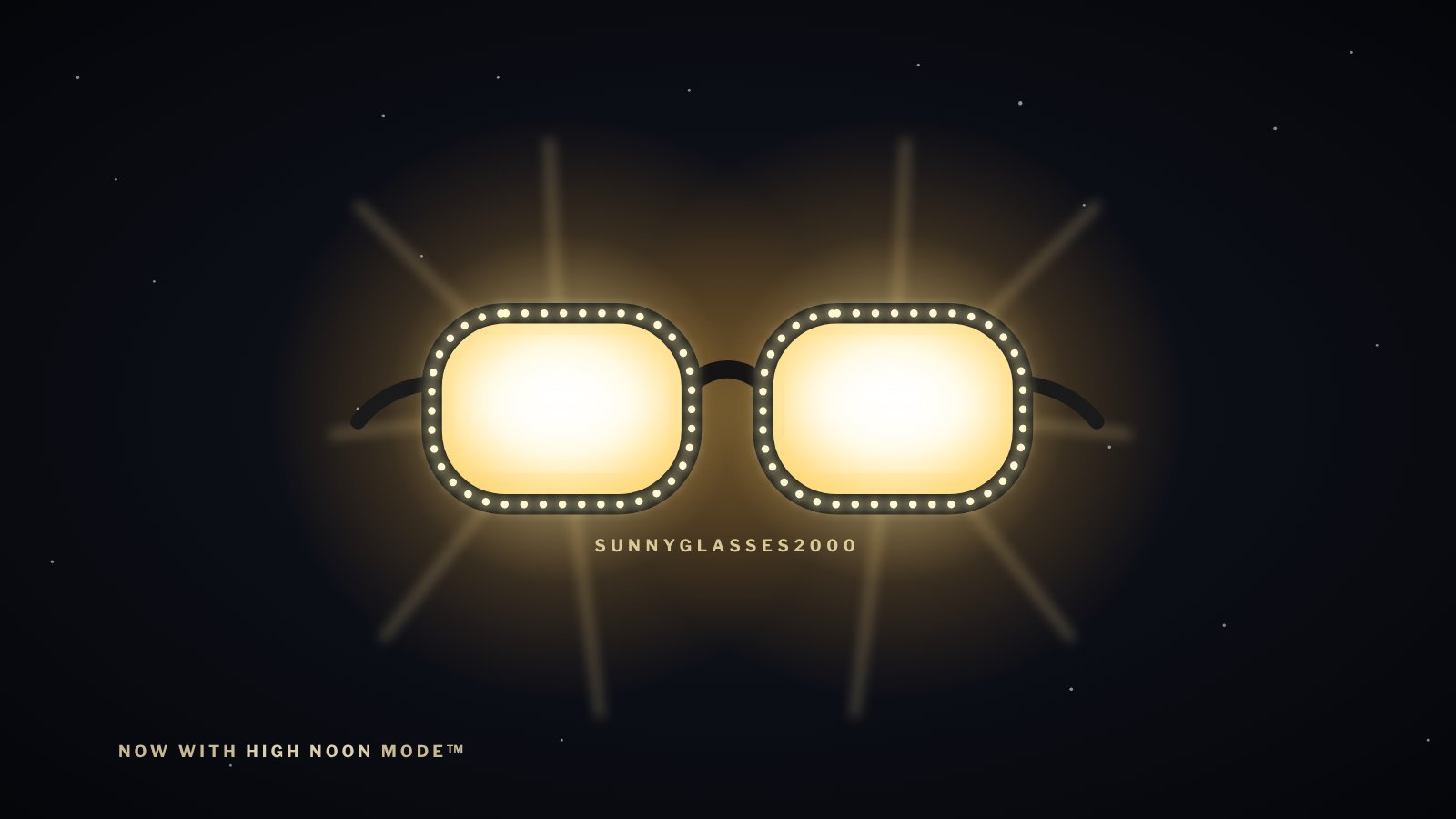
The SunnyGlasses2000 is made by Radiant Horizon Optics, LLC. It is a pair of eyeglasses with what the company calls a “Micro-Solar Emission Ring™” around each lens. According to the marketing, the ring holds a “low-level sunlight generator” that sends “authentic, daylight-grade illumination” straight into the wearer’s eyes.
The pitch goes like this. People see better in the daytime. Daytime has sunlight. So if you put sunlight into your eyes at night, you will see as if it were daytime.
I read this three times. I thought it was either the dumbest thing I had ever read or the smartest, and I could not tell which. In my experience, that is where fortunes are made and Pulitzers are won.
The glasses cost $349.99. Each pair comes with a carrying case, a USB-C cable, and a card that says “Never look directly at the sun. Except this one.”
I Consult an Expert
I don’t have a science background. I do have a subscription to an AI named Clyde, which I keep for research and because it’s the only one in my life who answers on the first ring.
Clyde. Hypothetically. If I shine sunlight into my eyes at night, will I see better?
No. You’ll see worse. At night, the problem isn’t that your eyes are too dark. It’s that everything else is.
Explain that like I’m a journalist.
You see an object because light bounces off it and reaches your eye. A tree in the dark is hard to see because no light is hitting the tree. Shining light into your eyes doesn’t light up the tree. It only lights up you.
So the glasses illuminate the wearer.
Brilliantly. Then your pupils constrict, your dark-adapted rod cells lose about twenty to thirty minutes of adjustment, and the faint light that was reaching you from the tree gets drowned out by glare. You’ll see a lovely bright haze and absolutely nothing else.
Like a headlight pointed the wrong way.
Exactly like that. A headlight pointed the wrong way.
Could that be a feature?
For whom?
I wrote “for whom” in my notebook and underlined it twice. That’s the kind of quote that wins awards. I’ve decided to attribute it to an “industry source.”
The “Sunlight Generator”
Radiant Horizon’s materials never explain how a pair of glasses generates sunlight. Our own sun manages it through nuclear fusion, at around fifteen million degrees Celsius in its core. If the SunnyGlasses2000 is doing the same thing, the emission ring is the most important energy breakthrough in human history, and the company has chosen to sell it as an accessory.
It’s almost certainly a ring of warm-white LEDs.
They say it’s “solar-spectrum calibrated.”
So is a lamp from a hardware store.
They say it’s “the same light the sun makes.”
If it really were, it would include ultraviolet, and you would be giving your corneas a sunburn at a range of about two centimeters. I’d honestly prefer it be the hardware-store lamp.
I asked Radiant Horizon whether the glasses emit UV light. A spokesperson answered in writing: “SunnyGlasses2000 emits only the good parts of sunlight.” I asked which parts those were. I’m still waiting.
Field Testing
Journalistic integrity required that I test the product myself. I also couldn’t get a refund in time.
I put on the SunnyGlasses2000 at 9:47 p.m. in the parking lot of my building and switched them to the highest setting, which the app calls “HIGH NOON.”
Here is what I observed, verbatim from my notes:
- 9:47 p.m. Bright. Very bright. Is this what success feels like?
- 9:48 p.m. Cannot see car.
- 9:48 p.m. Cannot see building.
- 9:49 p.m. Cannot see notebook. Writing this from memory.
- 9:52 p.m. Walked into a recycling bin. The bin was not illuminated. I was.
- 9:55 p.m. Neighbor asked whether I was “okay” and whether I was “some kind of lighthouse.”
I took the glasses off at 9:58. For the next twenty minutes I saw a floating green ring wherever I looked, and as it happens I could see that clearly.
The Testimonials
The SunnyGlasses2000 website carries 4,812 five-star reviews. That impressed me until I sorted them by date and found that 4,809 of them were posted on the same Tuesday, between 2:00 and 2:14 a.m.
Some highlights:
“I can finally see at night!!! 5 stars.” — Verified Buyer
“I can finally see at night!!! 5 stars.” — Verified Buyer
“I can finally see at nigh!!! 5 stars.” — Verified Buyer (the honest one, I suspect)
One review stood out. “Wore them driving home. Other drivers kept flashing their brights at me. Guess they were jealous.” I tried to reach this reviewer. Their profile picture was a stock photo of a man holding a salad.
The Sales Figures
This is where the story stops being about glasses and becomes about numbers, which is where real journalism lives and, I’m told, where prize committees look first.
Radiant Horizon’s latest press release claims “over 2.4 million units sold worldwide” in the third quarter alone. At $349.99 a pair, that comes to roughly $840 million in one quarter, which puts a pair of light-up glasses in the revenue range of a mid-sized airline.
I had some questions.
Radiant Horizon’s registered business address is Unit 114 of a self-storage facility outside Tampa. I visited. The unit has a padlock, a dehumidifier, and, through a gap under the door, what looks like a single cardboard box. A box that size could hold about forty pairs, and I’m being generous.
The company’s LinkedIn page lists one employee: the founder and CEO, Dale Brightman, whose title is “Founder, CEO, Visionary (Literally).”
I asked Clyde to help me make the numbers add up.
How would one company sell 2.4 million units out of one storage unit?
There are a few creative ways to count. “Units” could mean pairs, individual lenses, LEDs, or opinions. It could include pre-orders, abandoned carts, or people who looked at the website and felt something.
Is that legal?
I’m not a lawyer. But if a company publicly reports sales it didn’t make and investors rely on those numbers, that’s the sort of thing regulators take an interest in.
And that’s the sort of thing that wins awards.
You’ve said “award” eleven times in this conversation.
I’ve been counting too.
The Response
I sent Radiant Horizon a detailed list of questions about the physics, the UV output, the reviews, the storage unit, and the 2.4 million units. Mr. Brightman replied personally, after business hours. Given the product, that seems fitting.
His full statement:
“Ambrose, the haters said the same thing about the lightbulb. SunnyGlasses2000 is not just eyewear, it’s a lifestyle. Our sales numbers speak for themselves. Have you tried them on HIGH NOON?”
I have, Dale. That’s the problem.
Conclusion
After three weeks of investigation, one field test, one recycling bin, and a lingering green ring in my left eye, I’ve reached the following findings:
- The SunnyGlasses2000 doesn’t help you see at night. It helps other people see you at night, along with possibly some passing aircraft.
- The “low-level sunlight generator” is, at best, a ring of ordinary LEDs. At worst it’s an actual sun, and Radiant Horizon has much bigger problems than this article.
- The company’s reported sales appear to be what we in the profession call “aspirational.”
I’ve passed my findings along to the appropriate authorities, in the form of a strongly worded email to a general inquiries address. I’ve also passed them along to the judging committees of four journalism prizes, two of which I’m reasonably sure exist.
The night is still dark. But the truth, I’d argue, has never been brighter.
(That’s the line. Somebody write that down.)
Sources
- Clyde, an AI, interviewed by the author on several occasions, some of them voluntary.
- Radiant Horizon Optics, LLC, press release, “SunnyGlasses2000 Abolishes the Night.”
- SunnyGlasses2000 customer reviews, sorted by date, regrettably.
- Field notes of the author, parking lot, 9:47–9:58 p.m. Partially written from memory.
- Written statement of Dale Brightman, Founder, CEO, Visionary (Literally).
- A recycling bin, which declined to comment.
End of Report